Why is Psychology So Important?
💡 Imagine driving on the highway...
You passed your driving test, you know every rule, you have your license
But when a car cuts you off — you get angry and floor the accelerator to chase them
At that moment you know it is dangerous, but emotion overrides logic
Trading is the same! You might know you should cut your loss, but "hope" makes you hold on... until your account is gone
You passed your driving test, you know every rule, you have your license
But when a car cuts you off — you get angry and floor the accelerator to chase them
At that moment you know it is dangerous, but emotion overrides logic
Trading is the same! You might know you should cut your loss, but "hope" makes you hold on... until your account is gone
Many say Trading is 80% psychology and 20% technique. You might be great at analysis, but if you cannot control your emotions, you will still lose money.
⚠️ The truth you need to know:
The main reason traders lose money is not bad analysis
but making decisions driven by emotions like greed, fear, and anger
The main reason traders lose money is not bad analysis
but making decisions driven by emotions like greed, fear, and anger
⚠️ Dangerous Emotions to Watch Out For
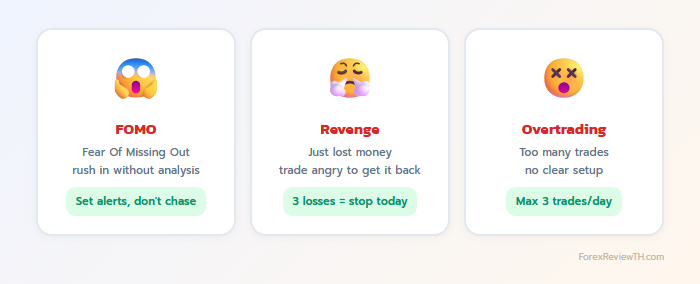
1. 😱 FOMO (Fear Of Missing Out)
Fear of missing an opportunity — seeing price move fast and jumping in without analysis because you are afraid of being left behind.
Symptoms:
- Seeing price shoot up → Rushing to Buy at the top because you fear missing out
- Seeing others post their profits → Wanting to jump in too
- Not analyzing beforehand, just feeling like "I have to enter now!"
Solutions:
- Have a plan before trading — Know where to enter before price gets there
- "The market always has opportunities" — You do not need to catch every move
- Set Alerts — Let price come to you, do not chase price
- Ask yourself: "If I had no position right now, would I still enter?"
2. 😤 Revenge Trading
Trading for revenge — just lost money, feeling angry, wanting to get it back immediately, so you trade right away driven by emotion.
Symptoms:
- Just hit Stop Loss → Opening a new order immediately
- Increasing position size to recover money faster
- Trading outside the plan because "I need to get my money back!"
Solutions:
- Set a rule: After 2-3 consecutive losses → Stop trading for the day
- Step away from the screen — Do something else for 15-30 minutes
- Remember: Losing is part of trading, it is not personal
- Never increase size — Always trade the same size
3. 📊 Overtrading
Trading too much — opening too many orders, trading too frequently without good reasons.
Symptoms:
- Multiple positions open simultaneously (more than 3-5)
- Trading every day, every hour, like an addiction
- Feeling like you "must trade" even without signals
- Losing more money to Spread/Commission than you earn in profit
Solutions:
- Set a maximum trade count — e.g. no more than 3 trades per day
- Wait for truly good signals — Quality over Quantity
- "Not trading is also trading" — Waiting is a good decision
- Trade higher timeframes — H4 or Daily
⚠️ Alarming statistic:
Research shows that the more frequently you trade, the higher your chance of losing money
Because Spread/Commission eats into profits + decision quality decreases
Research shows that the more frequently you trade, the higher your chance of losing money
Because Spread/Commission eats into profits + decision quality decreases
4. 😰 Fear
- Too afraid to open an order even when the signal is good
- Closing profitable trades too early because you fear the price will reverse
- Not daring to set a wide enough Stop Loss
5. 🤑 Greed
- Not taking profit because you want more → price reverses back to a loss
- Increasing position size because you "feel like you will win"
- Moving Take Profit further and further away
🧘 How to Control Your Emotions
1. Have a Trading Plan and Follow It
- Write your plan before trading — where to enter, where SL/TP goes
- Once you have a plan, follow it regardless of how you feel
- Do not change the plan mid-trade
2. Keep a Trade Journal
- Record every trade — reason for entry, result, emotions at the time
- Review weekly — identify which emotions cost you money
- Learn from your own patterns
3. Get Enough Rest
- Sleep enough — lack of rest = poor decisions
- Exercise — reduces stress
- Do not trade when not in good shape — sick, tired, or dealing with personal issues
4. Accept Losses
- Losses are the cost of doing business in trading
- Nobody wins every time — not even professionals
- Focus on long-term results, not individual trades
💡 Change your perspective:
A single loss = the cost of learning
If your Stop Loss is set correctly, a loss is just a controllable expense
A single loss = the cost of learning
If your Stop Loss is set correctly, a loss is just a controllable expense
5. Never Trade With Money You Cannot Afford to Lose
- Only use disposable income — money that will not affect your life if lost
- If you feel stressed every time you lose, you are using too much money
- Trading with money you are not afraid to lose = better decision making
📋 Pre-Trade Checklist
Ask yourself before opening any order:
- ✅ Is there a clear Technical/Fundamental reason?
- ✅ Am I following my plan?
- ✅ What is the Risk:Reward (at least 1:1.5)?
- ✅ Have I set Stop Loss and Take Profit?
- ✅ If I lose this trade, will I be okay with it?
- ✅ How am I feeling right now (calm, or angry/scared)?
Summary
- Psychology is more important than technique
- Watch out for FOMO, Revenge Trading, Overtrading
- Have a plan and follow it
- Keep a Trade Journal to learn from yourself
- Accept losses as part of the game
- Use money you can afford to lose for emotion-free decisions
🎯 Next Lesson: Time to get hands-on! — Open a Demo account, install MT4/MT5, and place your first order