💡 Imagine a company whose stock you want to buy...
Before buying, you would want to know: Is it profitable? Does it have a lot of debt? What is its future outlook?
Trading currencies is similar!
Instead of looking at a "company," we look at a "country" 🌍
• A country with a strong economy attracts investors → currency strengthens
• A country with a weak economy drives investors away → currency weakens
Before buying, you would want to know: Is it profitable? Does it have a lot of debt? What is its future outlook?
Trading currencies is similar!
Instead of looking at a "company," we look at a "country" 🌍
• A country with a strong economy attracts investors → currency strengthens
• A country with a weak economy drives investors away → currency weakens
What is Fundamental Analysis?
Fundamental Analysis (FA) is analyzing a country's "economic health" through economic data, central bank policies, and important news to predict whether a currency will strengthen or weaken.
💡 Simple formula:
Strong economy 💪 → Investors want in → High demand for currency → Currency strengthens
Weak economy 📉 → Investors flee → Low demand for currency → Currency weakens
Strong economy 💪 → Investors want in → High demand for currency → Currency strengthens
Weak economy 📉 → Investors flee → Low demand for currency → Currency weakens
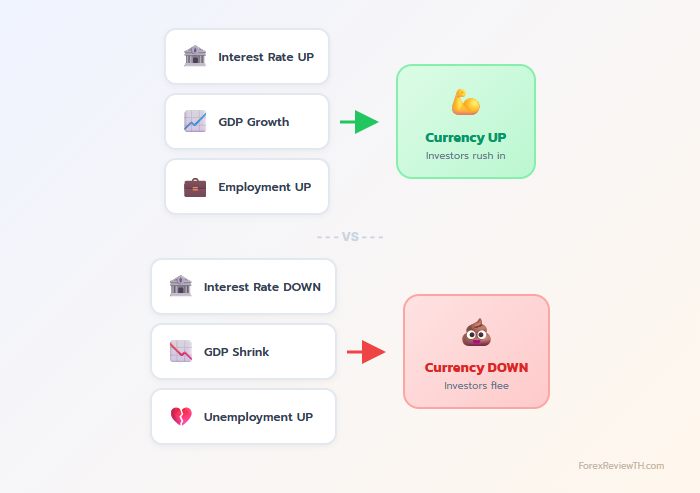
Factors That Affect Currency Value
1. 🏦 Interest Rate
💵 Imagine 2 savings accounts...
Bank A offers 5% interest
Bank B offers 1% interest
Where would you deposit? Bank A, of course!
Countries work the same way — a country with high interest rates attracts money inflows, strengthening its currency!
Bank A offers 5% interest
Bank B offers 1% interest
Where would you deposit? Bank A, of course!
Countries work the same way — a country with high interest rates attracts money inflows, strengthening its currency!
- The most important factor in Forex!
- High interest rates → Investors flock to deposit/invest → Currency strengthens
- Low interest rates → Money flows out seeking better returns → Currency weakens
- Follow central bank meetings: Fed (US), ECB (Europe), BOJ (Japan), BOE (UK)
2. Inflation
- High inflation → Purchasing power decreases → Currency weakens (long-term)
- High inflation → Central bank raises rates → Currency strengthens (short-term)
- Measured by CPI (Consumer Price Index)
3. Employment
- High employment = Strong economy → Currency strengthens
- High unemployment = Weak economy → Currency weakens
- Key data: NFP, Unemployment Rate
4. GDP (Gross Domestic Product)
- GDP growing → Strong economy → Currency strengthens
- GDP shrinking → Recession → Currency weakens
5. Trade Balance
- Exports > Imports (surplus) → Currency strengthens
- Imports > Exports (deficit) → Currency weakens
📰 Key Economic News Events
🇺🇸 Non-Farm Payroll (NFP)
| What is it | US non-agricultural employment figures |
| Released when | First Friday of each month at 8:30 AM EST |
| Impact | Very high! Price can move 50-100+ pips |
| Good number | USD strengthens (better than forecast) |
| Bad number | USD weakens (worse than forecast) |
📊 CPI (Consumer Price Index)
| What is it | Consumer Price Index, measures inflation |
| Released when | Monthly (varies by country) |
| Impact | High! Influences interest rate policy |
| CPI higher than expected | Rate hike expected → Currency strengthens |
| CPI lower than expected | Rate cut possible → Currency weakens |
🏦 FOMC Meeting
| What is it | Federal Reserve monetary policy meeting (US) |
| When | 8 times per year (approximately every 6 weeks) |
| Impact | Very high! Determines the direction of USD interest rates |
| What to watch | Statement, Dot Plot, Press Conference |
Major Central Banks of the World
- Fed (US) — Affects USD and global markets
- ECB (Europe) — Affects EUR
- BOJ (Japan) — Affects JPY
- BOE (UK) — Affects GBP
- RBA (Australia) — Affects AUD
- RBNZ (New Zealand) — Affects NZD
- BOC (Canada) — Affects CAD
- SNB (Switzerland) — Affects CHF
📅 Economic Calendar — An Essential Tool!
📆 An Economic Calendar is like an exam schedule...
Good students know when their exams are and which subjects to prepare for
Good traders know when news will be released and at what time to prepare accordingly!
If you do not check the calendar, you might get caught off-guard by major news 💀
Good students know when their exams are and which subjects to prepare for
Good traders know when news will be released and at what time to prepare accordingly!
If you do not check the calendar, you might get caught off-guard by major news 💀
The Economic Calendar lists all scheduled economic news releases from around the world. It is a tool that every trader must check daily!
💡 Recommended Economic Calendar websites (free!):
• Forex Factory — forexfactory.com (most popular)
• Investing.com — investing.com/economic-calendar
• Myfxbook — myfxbook.com/forex-economic-calendar
• TradingView — tradingview.com/economic-calendar
• Forex Factory — forexfactory.com (most popular)
• Investing.com — investing.com/economic-calendar
• Myfxbook — myfxbook.com/forex-economic-calendar
• TradingView — tradingview.com/economic-calendar
How to Read the Economic Calendar
- 🔴 Red / 3 stars — Very high impact! Extreme price volatility. Be careful!
- 🟠 Orange / 2 stars — Medium impact. Some price movement possible
- 🟡 Yellow / 1 star — Low impact. Usually does not move prices much
3 Numbers to Watch
- Previous — The value from the last release (for comparison)
- Forecast — What analysts predict the value will be
- Actual — The real value that is announced
💡 Key rule:
Actual > Forecast by a lot → Usually positive for that currency
Actual < Forecast by a lot → Usually negative for that currency
The bigger the deviation from forecast, the more volatile the price!
Actual > Forecast by a lot → Usually positive for that currency
Actual < Forecast by a lot → Usually negative for that currency
The bigger the deviation from forecast, the more volatile the price!
How to Trade Around News
🟢 For Beginners: Avoid Major News Events
- Close positions 15-30 minutes before news release
- Wait for the market to calm down (15-30 minutes after news)
- Then analyze the direction and enter a trade
🟡 For Experienced Traders: News Trading
- Analyze whether the actual number will beat or miss the forecast
- Prepare your position before the news
- Always set a Stop Loss!
⚠️ Warning: During major news:
• Spreads can widen 5-10x
• Prices can swing 50-200+ pips in minutes
• Slippage may occur (you get a different price than expected)
• Beginners should stay away!
• Spreads can widen 5-10x
• Prices can swing 50-200+ pips in minutes
• Slippage may occur (you get a different price than expected)
• Beginners should stay away!
TA vs FA: Which Should You Use?
The answer is use both!
- FA — Tells you the "direction" of a currency in the medium to long term
- TA — Tells you the "timing" for the best entry and exit points
💡 Example:
FA tells you the Fed will raise interest rates → USD should strengthen
TA tells you EUR/USD has pulled back to support + RSI is Oversold
→ Wait for EUR/USD to bounce, then look for a good Sell entry
FA tells you the Fed will raise interest rates → USD should strengthen
TA tells you EUR/USD has pulled back to support + RSI is Oversold
→ Wait for EUR/USD to bounce, then look for a good Sell entry
Summary
- FA analyzes economic factors: Interest rates, inflation, employment, GDP
- Key news: NFP, CPI, FOMC
- Use the Economic Calendar to check the news schedule daily
- Beginners should avoid trading during major news events
- Using FA + TA together gives the best results
🎯 Next Lesson: We will learn how to choose a broker — what to look for before opening an account, and brokers that are popular worldwide