🗣️ Imagine walking into a Japanese restaurant...
Waiter: "What size? S M L"
You: "L please" — Simple! You understand each other instantly.
Forex has its own "language" too
Learn these 5 terms first, and you can pick up the rest later 👇
Waiter: "What size? S M L"
You: "L please" — Simple! You understand each other instantly.
Forex has its own "language" too
Learn these 5 terms first, and you can pick up the rest later 👇
📌 5 Essential Terms (Just 5!)
1️⃣ Pip — The Unit of Price Movement
💡 Pip = Percentage in Point
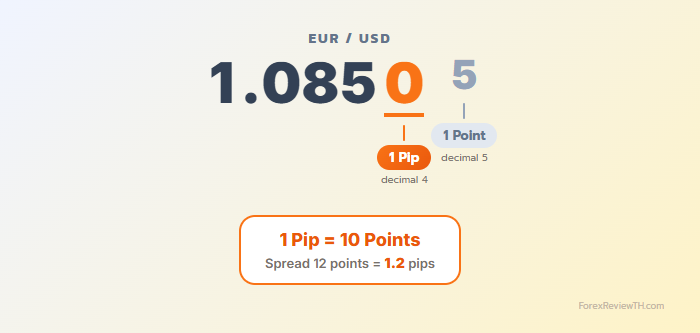
It is the 4th decimal place of the price (0.0001)
It is the 4th decimal place of the price (0.0001)
Examples:
- EUR/USD from 1.0850 → 1.0860 = moved up 10 pips
- EUR/USD from 1.0850 → 1.0851 = moved up 1 pip
⚠️ Exception: For JPY pairs, a pip is the 2nd decimal place
USD/JPY from 150.50 → 150.51 = 1 pip
USD/JPY from 150.50 → 150.51 = 1 pip
Pip vs Point — Do Not Confuse Them!
In MT4/MT5 you will see prices displayed with 5 decimals like 1.08505
| Term | Decimal Place | Example |
|---|---|---|
| Pip | 4th place | 1.08500 → 1.08510 |
| Point | 5th place | 1.08500 → 1.08501 |
🔢 Relationship: 1 Pip = 10 Points
When you see Spread = 12 in MT4, that means 12 points = 1.2 pips
(Most traders speak in pips because it is easier to understand)
When you see Spread = 12 in MT4, that means 12 points = 1.2 pips
(Most traders speak in pips because it is easier to understand)
2️⃣ Lot — "How much are you trading?"
💡 Lot = Order Size
Like ordering food — do you want small, medium, or large?
Like ordering food — do you want small, medium, or large?
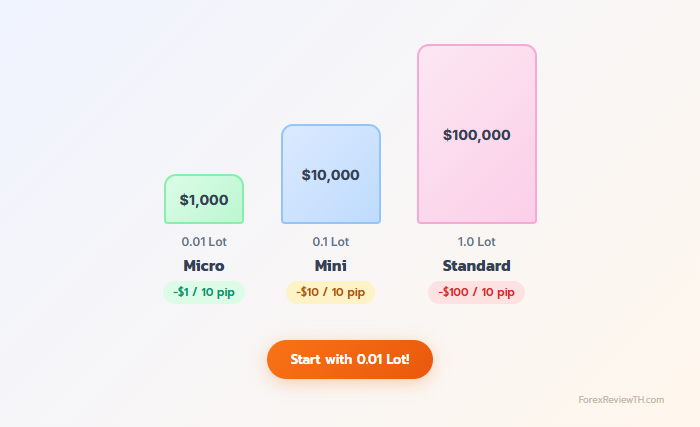
| Size | Equals | If wrong by 10 pips |
|---|---|---|
| 0.01 Lot (Micro) | $1,000 | Lose $1 👍 |
| 0.1 Lot (Mini) | $10,000 | Lose $10 |
| 1.0 Lot (Standard) | $100,000 | Lose $100 😰 |
🎯 Beginners: Start with 0.01 Lot only!
Even if you are wrong by 100 pips, you only lose $10 — learn without getting hurt
Even if you are wrong by 100 pips, you only lose $10 — learn without getting hurt
3️⃣ Spread — "The Trading Fee"
💡 Spread = The difference between the Buy and Sell price
Like exchanging money at a currency booth — the buy rate and sell rate are never the same
Like exchanging money at a currency booth — the buy rate and sell rate are never the same
Example:
- Buy price (Ask): 1.0852
- Sell price (Bid): 1.0850
- Spread = 2 pips — this is the broker's "fee"
Lower Spread = Better! The lower it is, the more you save
EUR/USD typically 0.5-2 pips / Exotic pairs can reach 20-50 pips
4️⃣ Leverage — "Borrowed Trading Power"
💡 Leverage = A Multiplier
You have $100 but can trade as if you have $10,000!
You have $100 but can trade as if you have $10,000!
Example with Leverage 1:100:
- You have $100
- The broker "lends" you another $9,900
- Total trading power: $10,000
⚠️ A Double-Edged Sword!
• 1% profit = earn $100 (even though you only deposited $100) 🎉
• 1% loss = lose $100 (your entire deposit!) 💀
Beginners: Use low leverage first (1:10 - 1:30)
• 1% profit = earn $100 (even though you only deposited $100) 🎉
• 1% loss = lose $100 (your entire deposit!) 💀
Beginners: Use low leverage first (1:10 - 1:30)
5️⃣ Margin — "Security Deposit"
💡 Margin = Collateral
Like booking a hotel — you pay a deposit upfront, but get it back at checkout
Like booking a hotel — you pay a deposit upfront, but get it back at checkout
When you open an order, the broker "locks" a portion of your funds as collateral.
Example:
- Trading $10,000 with Leverage 1:100
- Required Margin = $10,000 / 100 = $100
⚠️ Margin Call = Your funds are running low! You must deposit more or close orders
Stop Out = The broker forcefully closes your orders because you have insufficient funds
Stop Out = The broker forcefully closes your orders because you have insufficient funds
📝 Bonus Terms (Good to Know)
| Long / Buy | 🟢 Buy (expecting price to go up) |
| Short / Sell | 🔴 Sell (expecting price to go down) |
| Stop Loss (SL) | Auto-close to limit losses — extremely important! |
| Take Profit (TP) | Auto-close to lock in profits |
| Swap | Overnight holding fee for keeping orders open past market close |
🧮 Try Calculating!
Use these calculators to better understand Pips and Lots:
✅ Summary
5 Terms to Remember:
1️⃣ Pip = 4th decimal place (1 pip = 10 points)
2️⃣ Lot = Order size (start with 0.01)
3️⃣ Spread = Trading fee (lower is better)
4️⃣ Leverage = Borrowed trading power (be careful!)
5️⃣ Margin = Security deposit
1️⃣ Pip = 4th decimal place (1 pip = 10 points)
2️⃣ Lot = Order size (start with 0.01)
3️⃣ Spread = Trading fee (lower is better)
4️⃣ Leverage = Borrowed trading power (be careful!)
5️⃣ Margin = Security deposit
🎯 Next Lesson: Currency Pairs — How many types are there?
Why do some pairs have low Spreads while others are expensive?
Why do some pairs have low Spreads while others are expensive?